
From Dalek Nightmares to Big Questions: Why Doctor Who Has Found Its Way Back Into My Thoughts
There are certain television programmes that stay with you long after you've stopped watching them. For me, one of those programmes was Doctor Who.
I used to watch it when I was younger, although "watch" might not be the best word. Sometimes it felt more like a mixture of fascination and fear. I would sit there completely absorbed by what was happening on screen while simultaneously wishing some of the creatures would disappear and never return.
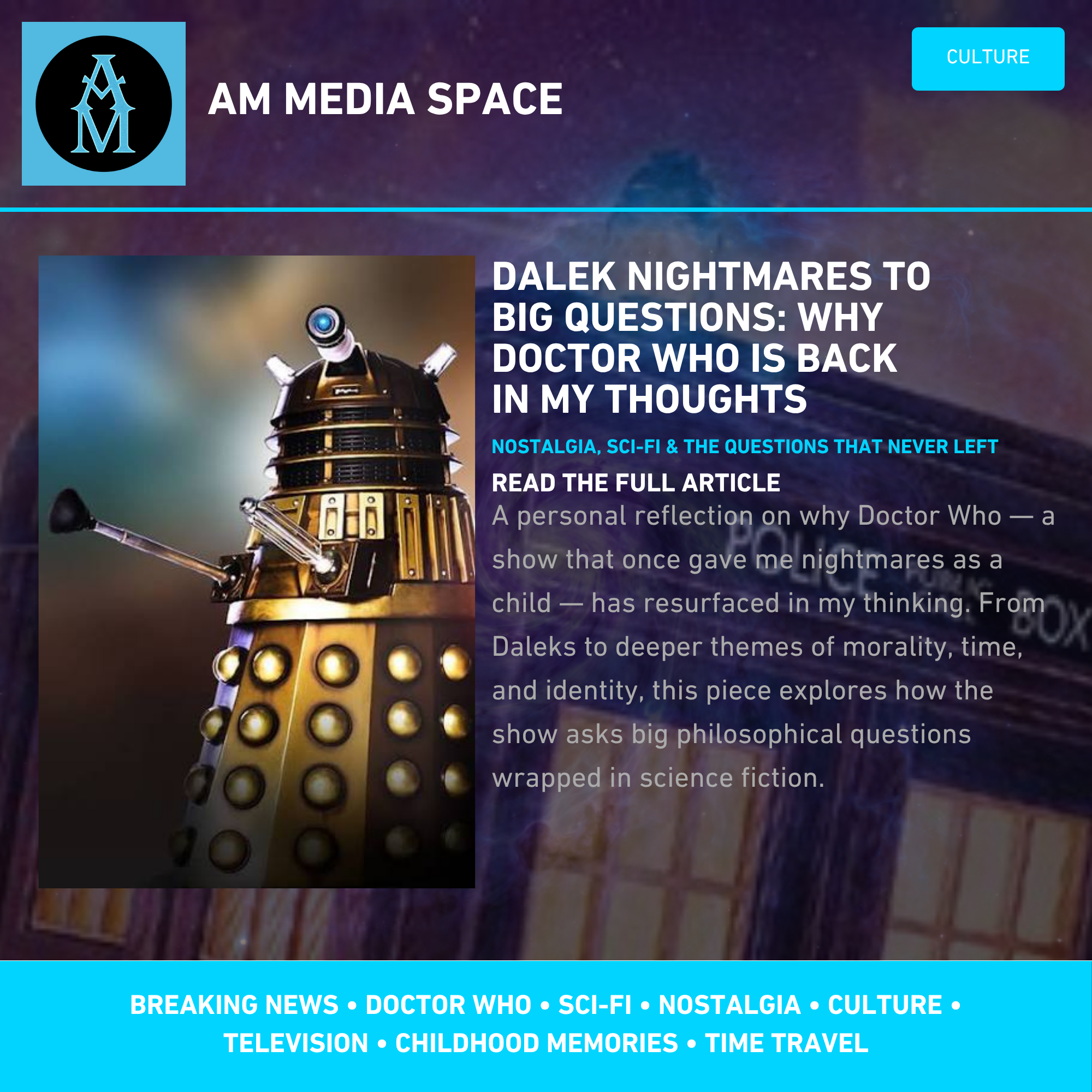
The Daleks were the worst for me.
Something about them genuinely frightened me as a child. Their voices, their appearance, their relentless nature, and the way they seemed incapable of reason or compassion all combined to create something that felt far more terrifying than many traditional monsters.
I remember having nightmares after watching certain episodes. Looking back now, it seems strange that a fictional science-fiction villain could have such an impact, but childhood imagination is a powerful thing.
The funny thing is that fear is often what makes stories memorable. Years later, I can still picture the Daleks far more clearly than many other television characters I watched growing up.
More Than Just Science Fiction
As I've grown older, I've come to realise that Doctor Who was never really just about monsters, aliens, or spaceships.
At its heart, it was asking much bigger questions.
Are we alone in the universe?
Could there be other worlds out there?
What would happen if humanity encountered life beyond Earth?
Those questions have fascinated people for generations, long before television ever existed.
When I was younger, I probably wasn't thinking about the science behind any of it. I was more concerned about avoiding another nightmare involving a Dalek chasing me down a corridor.
Now, however, I find the bigger questions far more interesting than the monsters themselves.
Do We Really Believe in Other Worlds?
One thing I often wonder is whether we, as a society, genuinely believe there are other worlds and intelligent life elsewhere in the universe.
On one hand, modern science has shown us just how enormous the universe really is.
We now know that there are billions of stars within our galaxy alone, and billions of galaxies beyond that. Around many of those stars are planets, some of which may have conditions suitable for life.
When you consider those numbers, it becomes difficult to imagine that Earth is the only place where life has ever emerged.
That doesn't mean little green men are flying around in spacecraft visiting us every weekend. It simply means the possibility of life elsewhere seems increasingly reasonable when viewed through the lens of probability.
The challenge is that possibility and proof are two very different things.
Despite decades of searching, humanity has yet to discover confirmed evidence of extraterrestrial life.
We have questions, theories, and plenty of speculation, but no definitive answers.
The Human Need to Wonder
Perhaps that's one reason science fiction remains so popular.
Programmes like Doctor Who allow us to explore possibilities without needing immediate answers.
They give us permission to imagine.
Whether it's aliens, time travel, alternate realities, or distant planets, these stories tap into something deeply human: curiosity.
We want to know what is beyond the horizon.
We want to understand whether we are alone.
We want to believe there may be something bigger than ourselves.
Even people who claim not to believe in aliens often find themselves looking up at the night sky and wondering what might be out there.
There is something universal about that feeling.
The World Feels Different Today
What strikes me now is how different the world feels compared to when I was growing up.
Technology has advanced at an incredible pace.
Artificial intelligence is becoming part of everyday life. Social media dominates communication. News travels across the globe in seconds.
In many ways, the future that science-fiction writers imagined decades ago has already begun to arrive.
Yet despite all of our technological progress, many of the biggest questions remain unanswered.
Who are we?
Where are we going?
And are we alone?
For all our advances, we still look towards the stars searching for meaning.
Looking Back at Childhood Fears
When I think about those Dalek nightmares now, I can't help but laugh.
At the time they felt very real. They represented something unknown and unstoppable.
Perhaps that's why they were so effective.
Fear often comes from things we don't understand.
As children, monsters represent the unknown. As adults, the unknown simply takes different forms.
The questions remain, even if the fears change.
What lies ahead?
What challenges will humanity face?
What discoveries are still waiting to be made?
A Final Thought
It is funny how something from childhood can unexpectedly find its way back into your thoughts years later.
I haven't followed Doctor Who for a very long time, and to be honest I have never watched the entire series from beginning to end.
Yet somehow those memories remain.
The Daleks.
The mystery.
The sense that there might be something out there beyond what we currently understand.
Perhaps that is why Doctor Who has endured for so many generations. It is not really about aliens or monsters. It is about curiosity.
It is about asking questions that humanity may never fully answer.
And although I have not watched Doctor Who properly for years, a small part of me is tempted to watch the new series that is out now.
Would I understand everything without having watched every episode from the beginning? Probably not.
But then again, maybe that was never the point.
After all, the best adventures often begin with stepping into the unknown.
Maybe it's time to find out whether the Doctor still has the ability to make me wonder — hopefully without giving me nightmares this time.
Comments