
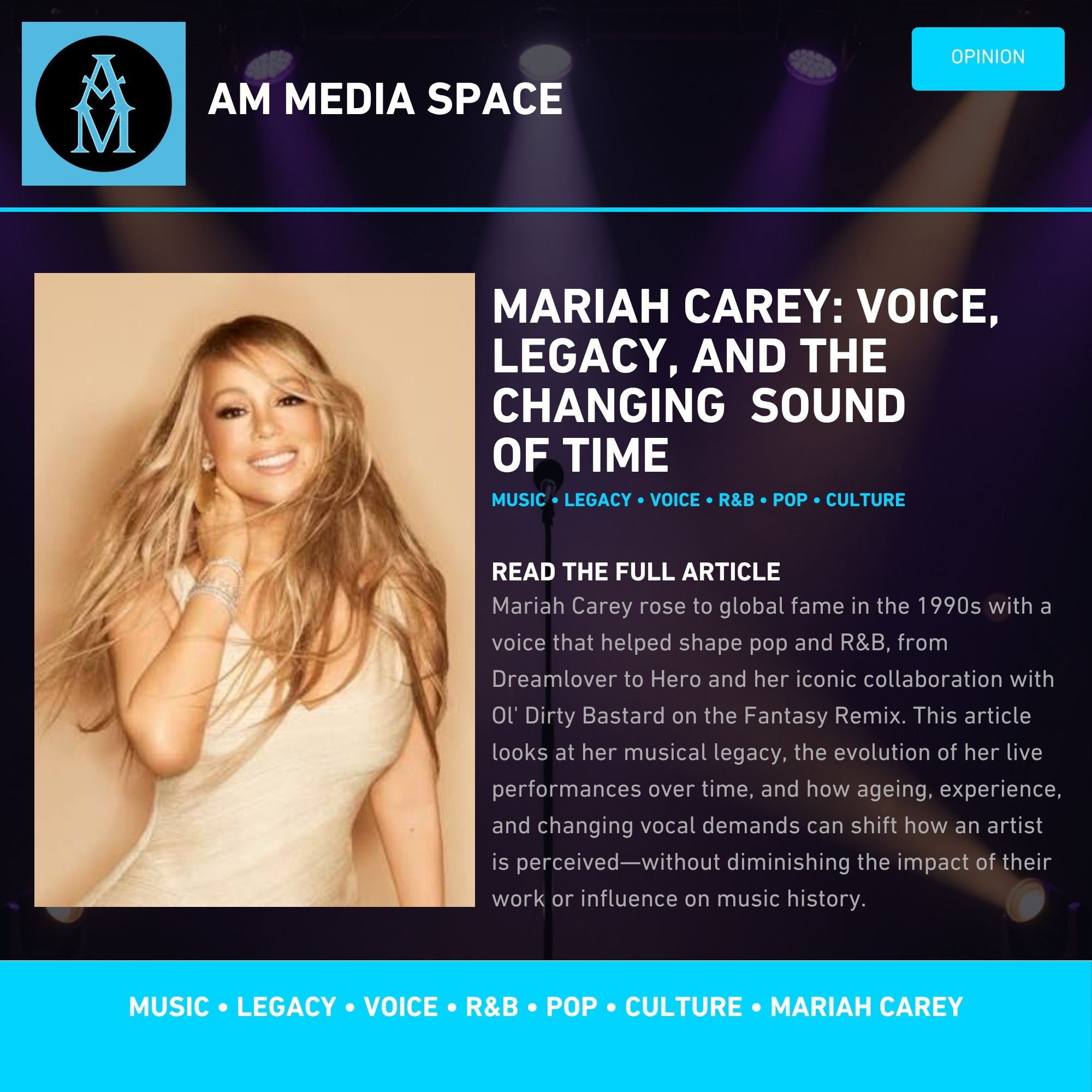
Mariah Carey: Voice, Legacy, and the Changing Sound of Time
Why do some voices feel untouchable in memory, but different when we hear them years later?
This is something I started thinking about while revisiting the music of Mariah Carey, especially early songs like Dreamlover and her collaboration with Ol' Dirty Bastard on the Fantasy Remix.
At one point in time, she was widely regarded as one of the greatest vocalists of her generation. Her range, control, and emotional delivery defined a large part of 1990s pop and R&B.
The Sound That Defined an Era
Mariah Carey emerged in the early 1990s with a voice that felt almost unmatched in commercial pop music.
Tracks like Dreamlover, Hero, and Fantasy were not only chart successes but cultural moments. They carried a sense of clarity and emotional lift that helped define an era of radio music.
Her collaboration with Ol' Dirty Bastard on the Fantasy Remix also marked a turning point in pop and hip-hop crossover culture, opening doors for more genre-blending collaborations in mainstream music.
Perception vs Time
In recent years, clips of live performances have circulated online, sparking debate about whether her voice is the same as it once was.
But what is often missing from that conversation is context: decades of touring, vocal strain, ageing, and the difference between studio recordings and live performance conditions.
What once felt effortless in a studio setting cannot always be reproduced in the same way decades later on stage.
Why It Feels Emotional to Fans
For many listeners, Mariah Carey’s early work is tied to memory, emotion, and personal history.
When a voice becomes part of someone’s emotional past, any change in that voice can feel personal—even symbolic.
This is not about loss of talent, but about how deeply music becomes embedded in memory and identity.
Where She Is Now
Today, Mariah Carey remains active in music, performance, and popular culture, continuing to release work and appear at major events while maintaining her legacy as one of the most successful vocalists in music history.
Her influence can still be heard in modern pop and R&B, particularly in vocal style, production choices, and genre blending.
Reflection
Rather than something being “taken,” what we may be experiencing is the natural distance between past and present.
Music does not stay still. Neither do voices. And sometimes what changes most is not the artist—but our relationship to the time we first heard them.
Comments