
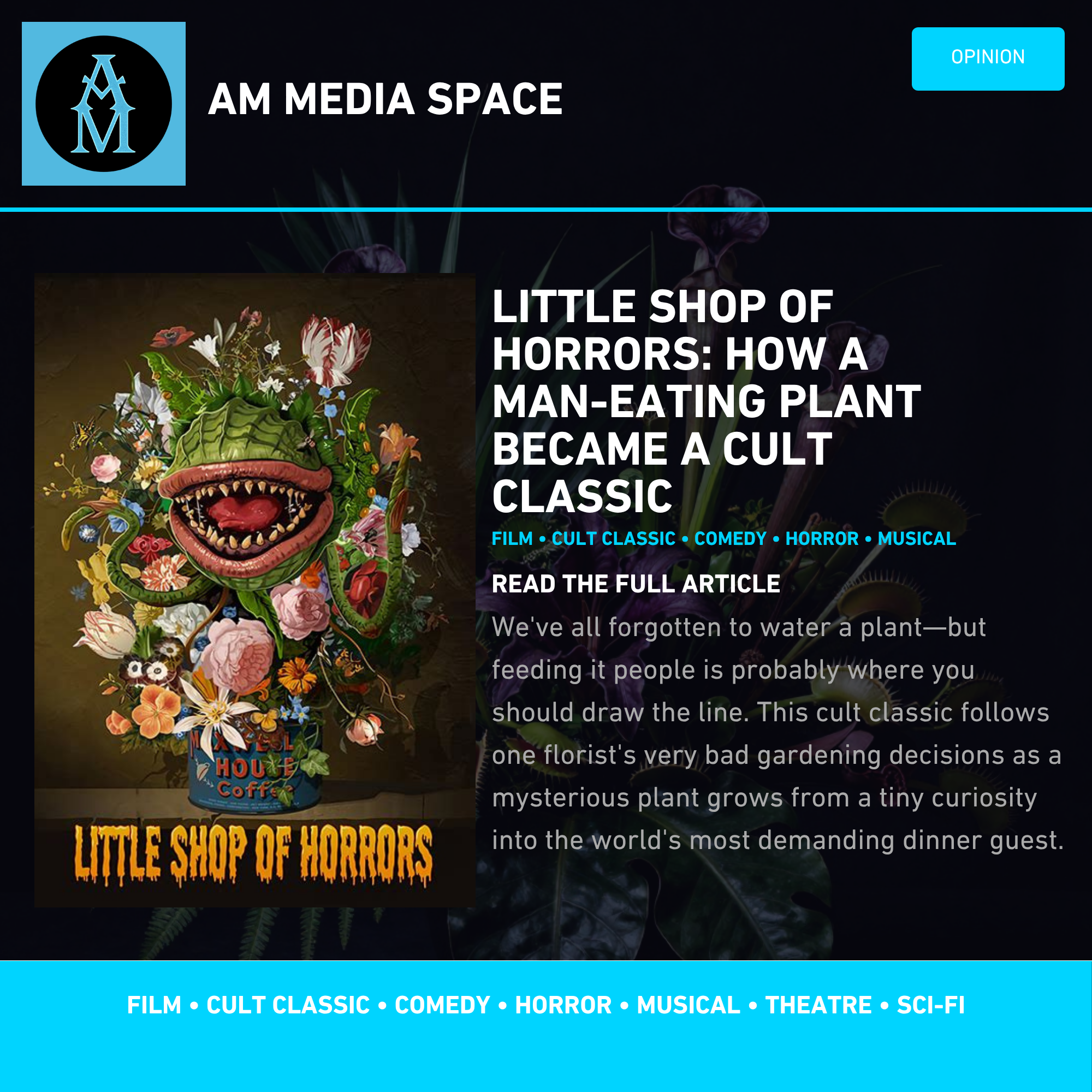
Little Shop of Horrors: The Musical That Turned a Man-Eating Plant into a Cult Classic
Few films have managed to combine horror, comedy, romance, and musical theatre as successfully as Little Shop of Horrors. Released in 1986 and directed by Frank Oz, the film has become one of the most beloved musical comedies ever made, introducing audiences to an unforgettable story centred around an unusual plant with an even more unusual appetite.
Based on the Off-Broadway stage musical by Alan Menken and Howard Ashman, which itself was inspired by Roger Corman's 1960 film The Little Shop of Horrors, the movie remains a favourite for generations of film lovers.
A Story That Blossoms into Horror
The story follows Seymour Krelborn, a shy and awkward florist working in a struggling flower shop on Skid Row. Hoping to impress his co-worker Audrey, whom he secretly loves, Seymour discovers a strange and mysterious plant following a solar eclipse.
He names the plant Audrey II.
What begins as an innocent curiosity soon becomes something far darker. Seymour discovers that Audrey II only survives by feeding on human blood. As the plant grows larger, it brings Seymour fame, fortune, and success, but the price becomes increasingly difficult to ignore.
The film cleverly explores themes of ambition, temptation, greed, and the consequences of sacrificing morality in pursuit of success.
An Unforgettable Cast
The film stars Rick Moranis as Seymour Krelborn and Ellen Greene as Audrey, reprising the role she originally performed on stage. Their performances are complemented by a memorable supporting cast including Vincent Gardenia as Mr. Mushnik, Steve Martin as the sadistic dentist Orin Scrivello, and Bill Murray in one of the film's funniest scenes.
Perhaps the biggest star, however, is Audrey II herself. Brought to life using groundbreaking puppetry and practical effects, the giant plant was voiced by legendary soul singer Levi Stubbs, whose powerful voice transformed Audrey II into one of cinema's most memorable villains.
The Music Behind the Magic
Much of the film's enduring popularity comes from its outstanding soundtrack.
Songs such as Little Shop of Horrors, Skid Row (Downtown), Somewhere That's Green, Suddenly, Seymour, and Feed Me (Git It) remain favourites among musical theatre fans.
The film also introduced Mean Green Mother from Outer Space, the first song written specifically for a film to receive an Academy Award nomination for Best Original Song.
Practical Effects That Still Impress
Long before computer-generated imagery became common, Little Shop of Horrors relied almost entirely on practical effects.
The enormous Audrey II puppet required multiple operators working together to control its movements and expressions. Even today, many filmmakers and audiences consider these practical effects more believable than modern CGI because they occupy the same physical space as the actors.
Why the Film Endures
Nearly four decades after its release, Little Shop of Horrors continues to entertain new audiences. Its mixture of humour, horror, romance, memorable songs, and timeless storytelling has earned it cult classic status.
The film also reminds viewers that success gained through unethical choices often comes at a price. Beneath its colourful musical numbers lies a cautionary tale about greed, temptation, and personal responsibility.
Final Thoughts
Little Shop of Horrors proves that some of the most unusual ideas can become cinematic classics. What could have been a simple comedy about a talking plant instead became a film celebrated for its creativity, music, performances, and practical effects.
Whether you're discovering it for the first time or revisiting it years later, the film remains one of the finest examples of how comedy, horror, and musical theatre can come together to create something truly unforgettable.
Comments