
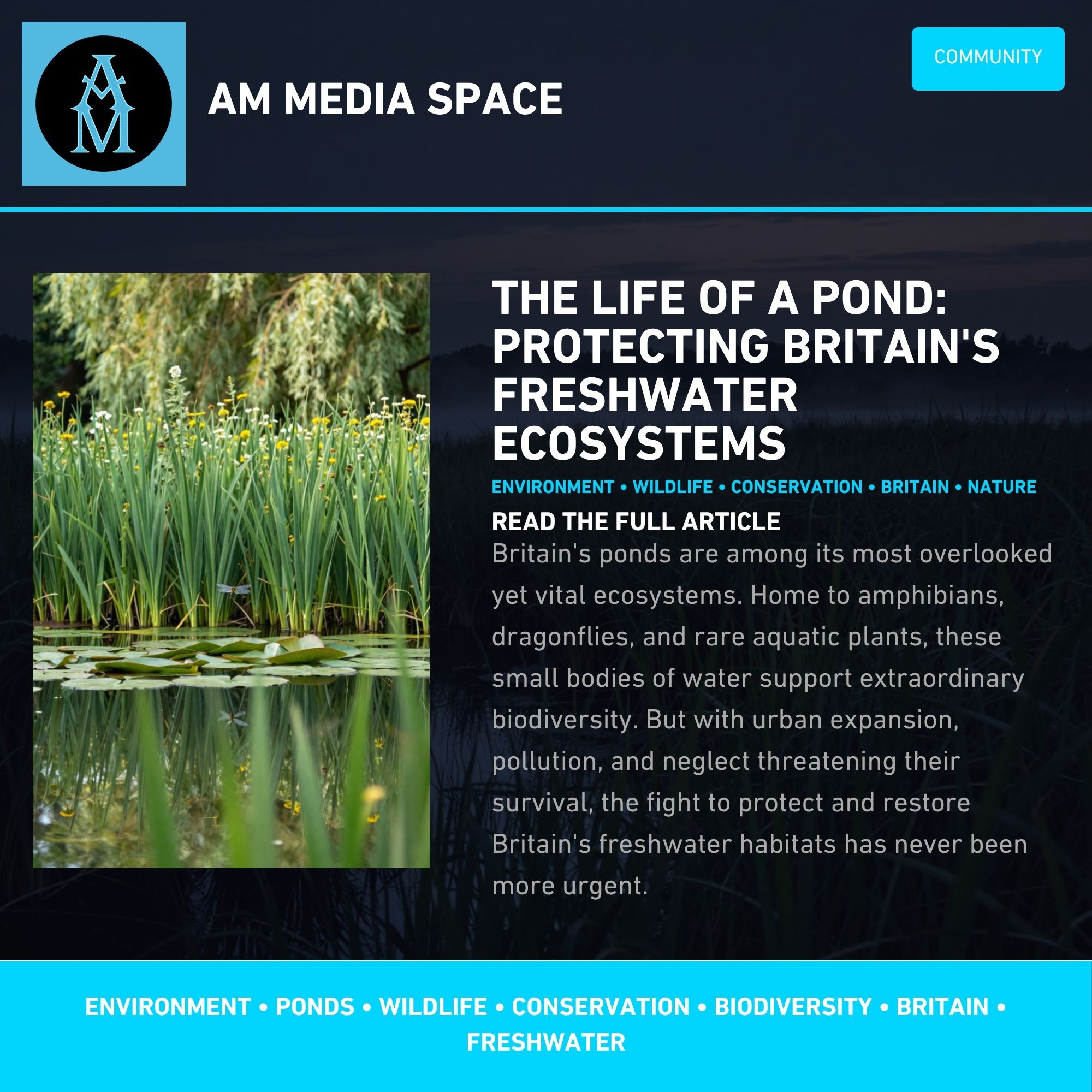
The Dramatic Decline of Pond Life: Why Britain's Smallest Waters Need Our Biggest Protection
Introduction
Hidden amongst woodland clearings, farmland, village greens, nature reserves, parks and even suburban gardens lies one of Britain's most important yet often overlooked habitats—the humble pond. While they may appear small and insignificant compared to rivers, lakes and wetlands, ponds are among the richest freshwater ecosystems in the United Kingdom. These tiny bodies of water support an astonishing variety of wildlife, providing breeding grounds, feeding areas and shelter for thousands of species ranging from microscopic organisms to amphibians, insects, mammals and birds.
Despite their importance, ponds have suffered a dramatic decline over the last century. Thousands have disappeared beneath housing developments, roads and intensive farmland, while many of those that remain are struggling against pollution, invasive species, neglect and the effects of climate change. Conservationists warn that unless action continues, many freshwater species could face an uncertain future.
Fortunately, this is not simply a story of decline. Across the United Kingdom, scientists, volunteers, charities, landowners and local communities are working together to restore ponds, protect endangered species and demonstrate that even small changes can have a significant impact on biodiversity.
This article explores the remarkable world of pond life, why these habitats are so important, the reasons behind their decline, and the people dedicating their time to ensuring Britain's ponds continue to thrive for generations to come.
Why ponds matter more than most people realise
Many people assume that ponds are simply small pools of standing water with little ecological value. In reality, the opposite is true. Scientific studies have repeatedly shown that ponds are among the most biodiverse freshwater habitats in Britain.
A single healthy pond may support hundreds of different species. Some spend their entire lives in the water, while others depend upon ponds for only part of their life cycle. Frogs, toads and newts return each spring to breed before spending much of the year on land. Dragonflies begin life underwater before emerging as spectacular flying insects. Birds rely on ponds for drinking water and food, while mammals such as bats hunt the insects that gather above the surface during warm evenings.
Researchers have found that ponds often contain more species than similarly sized sections of rivers or streams because each pond develops its own unique characteristics. Differences in depth, shade, vegetation, water chemistry and surrounding habitat create countless ecological niches where different plants and animals can flourish.
In many rural landscapes, ponds act as stepping stones that allow wildlife to move between larger habitats. A frog leaving one pond may travel hundreds of metres before reaching another suitable breeding site. Dragonflies patrol networks of ponds during summer, while birds visit multiple ponds throughout the day searching for food.
Without these connected habitats, many species become isolated, making populations less resilient and reducing genetic diversity.
A landscape that once overflowed with ponds
Britain has a long history of ponds. Some are natural, formed thousands of years ago when glaciers retreated at the end of the last Ice Age. Others were created by people for practical purposes, including watering livestock, powering mills, storing fish, providing drinking water or extracting clay and gravel.
During the nineteenth century and earlier, ponds were common features across the countryside. Almost every farm had at least one pond, villages maintained communal ponds, and large country estates often featured ornamental lakes alongside smaller wildlife ponds.
These waterbodies became woven into the landscape, supporting wildlife while also serving local communities.
However, the twentieth century brought significant changes.
The disappearance of Britain's ponds
Following the Second World War, agriculture underwent rapid intensification. Fields became larger, hedgerows were removed, drainage systems improved and machinery increased in size. Small ponds that once interrupted cultivation were frequently filled in to create larger areas for crops.
Urban expansion added further pressure. Housing developments, industrial estates and road construction often replaced natural habitats, including ponds that had existed for centuries.
Conservation organisations estimate that Britain has lost hundreds of thousands of ponds over the past century. Many surviving ponds have also deteriorated due to pollution, neglect or changes in land management.
The loss is particularly concerning because each pond represents an individual ecosystem. Unlike rivers, where species can often move along connected waterways, isolated ponds that disappear may take entire local populations of wildlife with them.
The hidden world beneath the surface
A pond may appear calm and still, but beneath the surface lies a bustling underwater community.
Microscopic algae produce oxygen through photosynthesis, providing the foundation of the food web. Tiny zooplankton drift through the water feeding on microscopic plants before becoming food themselves for aquatic insects and young amphibians.
Water fleas, freshwater shrimp, snails, worms and insect larvae all play essential roles in recycling nutrients and maintaining healthy ecosystems.
Among the vegetation lurk dragonfly nymphs, fearsome underwater predators capable of catching tadpoles, mosquito larvae and even small fish. Diving beetles patrol the open water, while caddisfly larvae build protective cases from sand, leaves and tiny stones.
Every square metre of a healthy pond supports a remarkable variety of life, much of which remains unnoticed by casual visitors.
Amphibians: Britain's pond specialists
Few animals are more closely associated with ponds than amphibians. Britain is home to several native amphibian species, each relying on freshwater habitats during crucial stages of their lives.
Every spring, common frogs emerge from winter shelter to breed in ponds. Females lay large masses of frogspawn that hatch into tadpoles before gradually developing legs and lungs.
Common toads undertake remarkable migrations, sometimes travelling over a kilometre to return to the very pond where they themselves were born. Their annual journeys often bring them into conflict with busy roads, prompting volunteers across the country to assist them safely during the breeding season.
Newts are perhaps the most fascinating pond inhabitants. Smooth newts and palmate newts are relatively widespread, while the great crested newt has become one of Britain's most carefully protected animals due to habitat loss and declining populations.
Unlike frogs, female newts carefully wrap each individual egg inside the leaves of aquatic plants, providing protection while the embryo develops.
Dragonflies: masters of two worlds
Dragonflies and damselflies are among the oldest groups of insects on Earth, with ancestors flying long before the first dinosaurs appeared.
Although adults may only live for a few weeks or months, most of their lives are spent underwater as aquatic nymphs. Depending on the species, this stage may last between one and five years.
These underwater hunters are equipped with extendable jaws capable of capturing prey with astonishing speed. Once fully developed, they climb out of the water, split their skin and emerge as the colourful adults familiar to visitors of ponds during summer.
The presence of diverse dragonfly species often indicates a healthy freshwater habitat.
Why pond life is disappearing
The decline of pond wildlife cannot be attributed to a single cause. Instead, it results from multiple pressures acting together over many decades.
Pollution remains one of the greatest threats. Fertilisers washed from farmland introduce excessive nutrients into ponds, encouraging rapid algal growth that reduces oxygen levels. Pesticides may kill aquatic insects directly or affect amphibian development.
Road runoff introduces oils, heavy metals and microplastics into nearby ponds, while litter can entangle wildlife or release harmful chemicals as it breaks down.
Climate change presents additional challenges. Longer periods of drought may cause shallow ponds to dry out before amphibian larvae complete their development. Conversely, more intense rainfall can wash pollutants into freshwater habitats.
Warmer temperatures may also favour invasive species that outcompete native wildlife.
Another significant issue is neglect. While ponds are natural habitats, they still benefit from occasional management. Without it, some become heavily shaded by trees or filled with accumulated sediment and decaying vegetation. This gradual process can eventually reduce open water, limiting breeding opportunities for amphibians and aquatic insects.
Invasive non-native plants such as New Zealand pigmyweed and floating pennywort can spread rapidly, forming dense mats that block sunlight and reduce oxygen. Likewise, releasing unwanted pet fish into wildlife ponds may dramatically alter ecosystems, as fish consume amphibian eggs, tadpoles and aquatic invertebrates.
A fragile future—but reasons for hope
Although the challenges facing Britain's ponds are considerable, there are encouraging signs that nature can recover when given the opportunity.
Scientists have discovered that restoring neglected ponds often leads to surprisingly rapid returns of wildlife. Dormant seeds buried beneath pond sediments can germinate decades later, while insects, amphibians and aquatic plants are remarkably capable of recolonising restored habitats.
This resilience has inspired a growing movement dedicated to bringing ponds back to life. Across Britain, conservation organisations, researchers, volunteers and local communities are proving that even small ponds can make a huge difference to biodiversity.
In Part Two, we explore the extraordinary species that depend upon ponds, the laws that protect them—including the great crested newt and other legally protected wildlife—the organisations leading restoration projects, and how abandoned "ghost ponds" are being brought back from beneath farmland after lying hidden for generations.
p>Protected Species, Conservation Laws and the Fight to Save Britain's Pond WildlifeThe wildlife found within Britain's ponds represents one of the country's richest collections of freshwater biodiversity. While many people associate ponds with frogs and ducks, these habitats support hundreds of species, some of which are found nowhere else. Many have experienced significant population declines during the past century, prompting governments, conservation organisations and researchers to introduce legal protections and restoration programmes.
Understanding which species depend upon ponds—and why they are protected—is essential to appreciating the importance of conserving these remarkable freshwater ecosystems.
The Great Crested Newt – Britain's Most Famous Pond Resident
Perhaps no pond species has received more attention than the great crested newt (Triturus cristatus). Recognisable by its dark, warty skin and the striking jagged crest developed by males during the breeding season, it is the largest native newt in the United Kingdom.
Great crested newts spend much of the year living in rough grassland, woodland, hedgerows and scrub. During spring they migrate to ponds where courtship, mating and egg-laying take place.
Unlike frogs, female great crested newts carefully fold each egg inside the leaves of aquatic plants. This remarkable behaviour helps conceal the eggs from predators while providing protection during development.
Although still found across much of England, Wales and parts of Scotland, populations have declined due to habitat loss, pond destruction, pollution and fragmentation of the countryside. As ponds disappear, newts become isolated, making it increasingly difficult for populations to survive over the long term.
For this reason, great crested newts receive one of the highest levels of legal protection available to wildlife in Britain.
Legal protection for the great crested newt
The great crested newt is protected under the Wildlife and Countryside Act 1981 as well as the Conservation of Habitats and Species Regulations 2017 in England and Wales (with equivalent legislation in Scotland and Northern Ireland).
It is generally an offence to deliberately capture, kill, injure or disturb great crested newts, or to damage or destroy their breeding sites or resting places without the appropriate licence. Because of these protections, developers often need ecological surveys before construction work begins where suitable habitat may be present.
Licences may be issued in certain circumstances, but only where strict legal tests are met and appropriate mitigation measures are put in place. These may include creating new ponds, improving terrestrial habitat or relocating animals under carefully controlled conditions.
Smooth and Palmate Newts
Britain is also home to smooth newts (Lissotriton vulgaris) and palmate newts (Lissotriton helveticus).
Smooth newts are the species most commonly encountered in garden ponds. During the breeding season males develop colourful markings and an attractive wavy crest before returning to a more subdued appearance later in the year.
Palmate newts are generally smaller and favour ponds in heathland, woodland and upland areas. Although they do not receive the same level of legal protection as great crested newts, they remain protected against certain forms of intentional harm under UK wildlife legislation.
Frogs and Toads
The common frog remains one of Britain's most recognisable amphibians. Every spring thousands of adults return to ponds to breed, often producing large masses of frogspawn that quickly transform into wriggling tadpoles.
However, frogs face increasing pressures from habitat fragmentation, disease, pollution and changing weather patterns.
Common toads have experienced particularly worrying declines in parts of Britain. Unlike frogs, toads often travel considerable distances between woodland and breeding ponds, meaning busy roads can become deadly obstacles during migration.
Volunteer 'Toads on Roads' patrols organised by conservation groups help thousands of toads safely cross roads each spring, demonstrating how local communities can make a significant difference to wildlife conservation.
The natterjack toad, Britain's rarest native toad, is even more vulnerable. It relies upon shallow pools on coastal sand dunes and heathland, making it one of the country's most specialised amphibians.
Dragonflies and Damselflies
Dragonflies are often described as indicators of healthy freshwater environments. Species such as the emperor dragonfly, broad-bodied chaser, southern hawker and four-spotted chaser rely upon clean ponds for breeding.
Their aquatic larvae are top predators within pond ecosystems, helping regulate populations of mosquito larvae and other aquatic insects.
Damselflies, including the beautiful banded demoiselle and azure damselfly, depend upon healthy aquatic vegetation where females lay their eggs.
Conservationists frequently monitor dragonflies because changes in their populations can provide valuable information about the health of freshwater habitats.
Water Voles – Britain's Fastest Declining Mammal
Although more commonly associated with slow-moving rivers and ditches, water voles also occupy ponds connected to suitable wetland habitats.
Once widespread throughout Britain, water vole populations have suffered dramatic declines due to habitat loss and predation by invasive American mink.
Water voles are legally protected under the Wildlife and Countryside Act 1981, making it an offence to intentionally damage or destroy occupied burrows or disturb animals in certain circumstances.
Grass Snakes
Britain's largest native reptile, the grass snake, is closely linked to ponds because frogs and toads form an important part of its diet.
Grass snakes are excellent swimmers and may often be seen gliding through ponds in search of prey. Although harmless to humans, they have experienced declines caused by habitat loss and fragmentation.
The Hidden Army of Pond Invertebrates
Much of a pond's biodiversity comes from its invertebrates.
Diving beetles, water boatmen, pond skaters, freshwater shrimp, water spiders, caddisflies, mayflies, freshwater snails and countless microscopic organisms all contribute to a healthy ecosystem.
Many of these creatures perform vital ecological roles by recycling nutrients, controlling algae, pollinating aquatic plants or providing food for fish, amphibians and birds.
Because many pond invertebrates are highly sensitive to pollution, their presence often reflects the quality of the water.
The Plants That Hold Everything Together
Healthy ponds depend upon a diverse range of native aquatic plants.
Water crowfoot, hornwort, water forget-me-not, marsh marigold, yellow flag iris, water mint and flowering rush provide shelter, food and breeding sites for countless species.
Submerged plants oxygenate the water, while emergent vegetation stabilises pond edges and reduces erosion.
Without these plants, many pond animals would struggle to complete their life cycles.
When Good Intentions Cause Harm
Many problems affecting ponds arise through well-meaning but inappropriate actions.
Releasing unwanted goldfish or ornamental fish into wildlife ponds can devastate amphibian populations by consuming eggs and tadpoles.
Similarly, introducing non-native aquatic plants purchased for ornamental ponds can allow invasive species to escape into natural habitats.
Even feeding ducks excessively can alter water quality by increasing nutrient levels, encouraging algal blooms and reducing oxygen available to aquatic wildlife.
The Laws Protecting Pond Wildlife
Britain has developed a comprehensive framework of wildlife legislation designed to protect important species and habitats.
The Wildlife and Countryside Act 1981 remains one of the most significant pieces of environmental legislation, protecting numerous animals, birds and plants while regulating activities that could damage wildlife.
The Conservation of Habitats and Species Regulations 2017 provide additional protection for European Protected Species, including the great crested newt.
Planning authorities also consider biodiversity during development proposals. Developers may be required to carry out ecological surveys, avoid sensitive habitats or create replacement ponds where impacts cannot be avoided.
The introduction of Biodiversity Net Gain in England has further strengthened expectations that many developments should leave biodiversity in a measurably better state than before work began.
The Organisations Leading Pond Conservation
Across Britain, numerous organisations are helping reverse the decline of pond habitats.
The Freshwater Habitats Trust has become one of the country's leading freshwater conservation charities. It works with landowners, researchers and volunteers to restore ponds, create new habitats and improve freshwater biodiversity across landscapes.
Froglife focuses on conserving amphibians and reptiles while inspiring communities to create wildlife-friendly spaces through practical conservation projects and education.
The Wildlife Trusts manage thousands of nature reserves containing ponds, wetlands and marshes, while local volunteer groups undertake habitat management, species surveys and practical restoration work.
Amphibian and Reptile Conservation works to protect some of Britain's rarest reptiles and amphibians through scientific research, habitat restoration and public engagement.
Universities across the country are also contributing important research into pond ecology, helping conservationists understand how habitats respond to restoration and climate change.
Ghost Ponds – Bringing History Back to Life
One of the most exciting conservation successes of recent years has been the restoration of 'ghost ponds'.
Ghost ponds are former farmland ponds that were deliberately filled in, often during agricultural intensification after the Second World War. For decades they remained hidden beneath cultivated fields.
Researchers discovered that many still contained viable seeds, spores and dormant aquatic life buried beneath the soil.
When carefully excavated, these ponds often returned to life with astonishing speed. Native aquatic plants emerged from seed banks that had remained dormant for over a century, while insects, amphibians and birds quickly recolonised the restored habitats.
The success of ghost pond restoration has transformed conservation thinking, proving that even habitats thought to have been lost forever can sometimes be revived.
Hope for the Future
Although many pond species remain under pressure, conservation projects across Britain demonstrate that recovery is possible. Restored ponds frequently become wildlife hotspots within only a few years, attracting amphibians, dragonflies, birds and mammals back into landscapes where they had long been absent.
In the final part of this article, we will explore how members of the public can help protect pond wildlife, how schools and communities are creating new ponds, the role of citizen science, and why every garden pond has the potential to become a miniature nature reserve supporting Britain's remarkable freshwater biodiversity.
How Everyone Can Help Save Britain's Pond Life
One of the most encouraging aspects of pond conservation is that almost anyone can make a positive difference. Unlike many environmental issues that require large-scale government action or international agreements, pond restoration can begin in local communities, schools, farms, parks and even private gardens.
Every pond, regardless of its size, has the potential to support wildlife. Even a small garden pond measuring only a few square metres can quickly become home to frogs, newts, dragonflies, water beetles and a remarkable variety of aquatic insects.
Scientists have found that networks of smaller ponds can be just as important as larger wetlands because they create connected habitats across the landscape. These "stepping stones" allow wildlife to move safely between breeding sites, increasing genetic diversity and making populations more resilient to environmental change.
Creating a Wildlife-Friendly Pond
Many people assume that building a pond requires specialist knowledge or expensive equipment. In reality, a successful wildlife pond is often surprisingly simple.
Choosing a sunny location with gently sloping sides allows animals such as hedgehogs, frogs and newts to enter and leave the water safely. Different water depths create a wider variety of habitats, while areas of shallow water warm more quickly in spring, encouraging amphibians to breed.
Native aquatic plants are among the most important features of any wildlife pond. Species such as marsh marigold, water mint, hornwort, water crowfoot and yellow flag iris provide oxygen, shelter, breeding sites and food for countless organisms.
Adding logs, stones and areas of longer grass around the pond creates additional habitat for insects, amphibians and reptiles. These terrestrial areas are just as important as the water itself because many pond animals spend most of their lives on land.
What Not to Do
While creating a pond is relatively straightforward, there are several common mistakes that can unintentionally harm wildlife.
Introducing ornamental fish such as goldfish or koi may seem attractive, but these fish frequently eat amphibian eggs, tadpoles and aquatic insects, significantly reducing biodiversity.
Chemical treatments designed to keep water crystal clear should also be avoided wherever possible. Wildlife ponds naturally contain algae and aquatic plants, and these form an important part of the ecosystem.
Cleaning a pond too thoroughly can remove valuable habitats. Fallen leaves, decaying vegetation and areas of marginal growth all support insects and microorganisms that contribute to the pond's health.
If maintenance is necessary, it should be carried out gradually and preferably outside the main breeding season, allowing wildlife time to recover.
The Importance of Citizen Science
Modern conservation increasingly relies upon members of the public.
Thousands of volunteers across the United Kingdom now take part in wildlife recording schemes, submitting observations of frogs, dragonflies, aquatic plants and other species. These records help scientists monitor population changes, identify important habitats and understand how climate change is affecting wildlife.
Citizen science projects have transformed conservation by providing millions of records that would otherwise be impossible for researchers to collect alone.
Photographs submitted by members of the public also help experts identify rare species and monitor invasive plants before they become widespread.
Schools and Community Projects
Schools have increasingly recognised the educational value of ponds. A single school pond can become an outdoor classroom where pupils learn about ecology, life cycles, food chains, water quality and biodiversity.
Many children experience their first close encounter with wildlife while pond dipping under careful supervision. Observing tadpoles develop into frogs or watching dragonflies emerge from their aquatic larvae often inspires a lifelong interest in conservation.
Community groups have also embraced pond restoration. Volunteers regularly remove litter, control invasive species, plant native vegetation and monitor wildlife. These projects not only improve habitats but also strengthen local communities by bringing people together with a shared purpose.
The Challenge of Climate Change
Climate change presents one of the greatest long-term threats to Britain's freshwater habitats.
Hotter summers are increasing the frequency of droughts, causing many shallow ponds to dry out before amphibians complete their life cycles. Conversely, heavier rainfall can wash pollutants, fertilisers and sediment into ponds, reducing water quality.
Changing temperatures may also alter the timing of breeding seasons, affecting relationships between predators and prey.
Despite these challenges, healthy networks of ponds are more resilient than isolated habitats. Restoring multiple ponds across landscapes gives wildlife greater opportunities to move, adapt and survive changing environmental conditions.
Farming and Pond Conservation
Farmers are playing an increasingly important role in freshwater conservation.
Many landowners are restoring old ponds, creating buffer strips around water bodies and reducing the amount of fertiliser and pesticides entering freshwater habitats.
Some farms have even re-excavated long-forgotten ghost ponds, demonstrating that productive agriculture and biodiversity conservation can successfully coexist.
Agri-environment schemes have encouraged many farmers to protect ponds while maintaining profitable businesses, benefiting wildlife as well as improving water quality.
Urban Ponds Matter Too
Pond conservation is not limited to the countryside.
Urban parks, housing developments, school grounds and community gardens all have the potential to support thriving freshwater ecosystems.
Many town and city ponds provide valuable refuges for wildlife surrounded by buildings and roads. They also improve people's wellbeing by creating attractive green spaces where communities can connect with nature.
Research suggests that access to natural environments can benefit both physical and mental health, making pond conservation valuable for people as well as wildlife.
Dispelling Common Myths
Several myths continue to discourage people from creating or protecting ponds.
One common misconception is that ponds inevitably become mosquito breeding sites. In reality, healthy ponds usually contain dragonfly larvae, diving beetles and other predators that naturally control mosquito populations.
Another myth suggests that ponds require constant maintenance. Well-designed wildlife ponds often become largely self-sustaining after the first few years, needing only occasional management.
Some people also believe that small ponds have little ecological value. Scientific research has repeatedly shown that even tiny ponds can support impressive biodiversity when managed appropriately.
Looking Towards the Future
The future of Britain's ponds depends upon continued collaboration between governments, conservation organisations, researchers, landowners, schools, local authorities and the public.
There is growing recognition that ponds should no longer be viewed as isolated features but as essential components of wider ecological networks. Restoring multiple ponds across landscapes helps wildlife move more freely and increases resilience to environmental change.
New technologies, including environmental DNA (eDNA) surveys, are transforming how scientists monitor pond wildlife. By analysing tiny traces of genetic material left behind in water, researchers can detect species such as great crested newts without disturbing them, making surveys faster, less invasive and more accurate.
Conservation strategies are also becoming increasingly ambitious. Rather than simply protecting existing ponds, organisations are now creating entirely new pond networks designed specifically to support biodiversity recovery.
Why Every Pond Matters
It is easy to overlook a small pond when compared with dramatic landscapes such as mountains, forests or coastlines. Yet these modest freshwater habitats quietly support an extraordinary variety of life.
A single pond may contain breeding amphibians, hunting dragonflies, diving beetles, water snails, aquatic plants, birds searching for food, bats feeding overhead and countless microscopic organisms working unseen beneath the surface.
Each species plays a role in maintaining the delicate balance of the ecosystem. Remove one element and the effects may ripple throughout the entire food web.
The loss of Britain's ponds represents more than the disappearance of water. It represents the gradual loss of biodiversity, ecological resilience and natural heritage. Every pond filled in, polluted or neglected reduces opportunities for wildlife to survive in an increasingly fragmented landscape.
Fortunately, there is genuine reason for optimism. Across the country, restored ponds are once again echoing with the calls of frogs, shimmering with dragonflies and providing safe breeding sites for newts. Ghost ponds hidden beneath farmland for generations are returning to life, while new wildlife ponds are appearing in schools, gardens and nature reserves.
These successes demonstrate one important truth: nature is remarkably resilient when given the chance.
Conclusion
The story of Britain's ponds is both a warning and a source of hope. Decades of habitat loss, pollution, climate change and development have placed enormous pressure on freshwater ecosystems, yet conservation efforts show that recovery is possible.
Protected species such as the great crested newt have become symbols of why legal safeguards matter, while charities, scientists and volunteers continue to demonstrate that restoring even a single pond can have lasting benefits for biodiversity.
As awareness grows, ponds are finally receiving the recognition they deserve—not simply as attractive landscape features, but as some of Britain's richest and most valuable habitats.
Whether through restoring an old farm pond, creating a small garden pond, supporting conservation charities or simply appreciating the wildlife on our doorstep, everyone has a role to play.
In a rapidly changing world, every restored pond is a reminder that conservation does not always require vast landscapes or complex engineering. Sometimes, protecting nature begins with a patch of still water, alive with frogs, newts, dragonflies and the countless other species that depend upon it.
By safeguarding Britain's ponds today, we are helping to ensure that future generations inherit landscapes where freshwater wildlife continues to thrive, enriching our countryside, our towns and our lives for many years to come.
Did You Know?
• A single healthy pond can support hundreds of different species of plants, insects, amphibians, birds and mammals.
• Dragonflies have existed for more than 300 million years, making them older than the dinosaurs.
• Great crested newts can live for over 15 years in the wild under favourable conditions.
• Some pond plants can remain dormant beneath the soil for decades before growing again when a pond is restored.
• Britain's "ghost ponds" have been successfully brought back to life after lying buried beneath farmland for more than 100 years.
• A wildlife pond should never contain ornamental fish if the aim is to encourage frogs, newts and aquatic insects.
• Even a pond measuring just a few square metres can become an important refuge for wildlife.
• Bats often feed above ponds because the abundance of insects provides an excellent hunting ground.
• Many amphibians return to the very same pond where they were born to breed.
• Pond water naturally contains thousands of microscopic organisms that form the foundation of the freshwater food web.
A Brief Timeline of Pond Conservation in Britain
1940s–1960s: Agricultural intensification leads to thousands of farmland ponds being filled in to create larger fields.
1981: The Wildlife and Countryside Act is introduced, providing important legal protection for many native plants and animals.
1990s: Growing awareness of declining amphibian populations encourages more habitat restoration projects.
2000s: Large-scale pond creation and restoration projects begin across the UK, supported by charities, researchers and volunteers.
2010s: Scientists demonstrate that "ghost ponds" buried for decades can be successfully restored, allowing wildlife to rapidly return.
2020s: Environmental DNA (eDNA) technology becomes an increasingly valuable tool for monitoring protected species such as the great crested newt without disturbing their habitats.
10 Iconic Species You May Find Around Britain's Ponds
Great Crested Newt – Britain's largest and most heavily protected native newt, famous for its impressive breeding display.
Smooth Newt – The most common newt found in garden ponds throughout much of the UK.
Common Frog – One of Britain's best-known amphibians, recognised by its familiar springtime frogspawn.
Common Toad – Famous for its annual breeding migrations, often assisted by volunteers during road crossings.
Emperor Dragonfly – Britain's largest dragonfly, capable of catching insects while flying at remarkable speeds.
Broad-bodied Chaser – One of the first dragonflies to appear in late spring and a favourite among wildlife enthusiasts.
Grass Snake – Britain's largest native snake and an excellent swimmer that feeds mainly on amphibians.
Water Vole – Once widespread across Britain, now one of the country's fastest-declining native mammals.
Kingfisher – Although more commonly associated with rivers, kingfishers regularly visit ponds rich in aquatic life.
Daubenton's Bat – Often called the "water bat", this remarkable species skims insects directly from the pond's surface.
How to Identify Britain's Native Newts
Great Crested Newt – Large, dark brown or black with rough, warty skin. Breeding males develop a dramatic jagged crest along their backs and tails.
Smooth Newt – Smaller with smooth skin. Breeding males develop a wavy crest and bright orange belly marked with black spots.
Palmate Newt – Usually the smallest native species. Males develop distinctive webbed hind feet and a thread-like tip on the tail during the breeding season.
How You Can Help Pond Wildlife Today
? Create a wildlife pond using native aquatic plants.
? Avoid introducing fish into wildlife ponds.
? Leave areas of long grass and logs around ponds for shelter.
? Avoid using pesticides and herbicides near freshwater habitats.
? Join local wildlife surveys and record amphibian sightings.
? Support conservation charities working to restore freshwater habitats.
? Help keep ponds free from litter and invasive species.
? Encourage schools and community groups to create educational wildlife ponds.
Further Reading and Conservation Organisations
If this article has inspired you to learn more or become involved in pond conservation, several organisations provide excellent advice, volunteer opportunities and educational resources.
These include the Freshwater Habitats Trust, Froglife, The Wildlife Trusts, Amphibian and Reptile Conservation (ARC), Natural England, NatureScot and Natural Resources Wales. Their work continues to protect some of Britain's most valuable freshwater habitats while inspiring thousands of people to become involved in conservation every year.
Final Thought
Every pond tells a story. Some are centuries old, hidden within ancient woodlands or nestled beside quiet country lanes. Others are newly created in school grounds, parks or back gardens. Regardless of their age or size, each pond offers wildlife a place to breed, feed and thrive.
Protecting pond life is about far more than saving individual species. It is about preserving entire ecosystems, safeguarding Britain's natural heritage and ensuring that future generations can continue to experience the remarkable sights and sounds of healthy freshwater habitats. Every restored pond is a step towards a richer, more resilient natural world.
Comments